Same Air, Different Journey
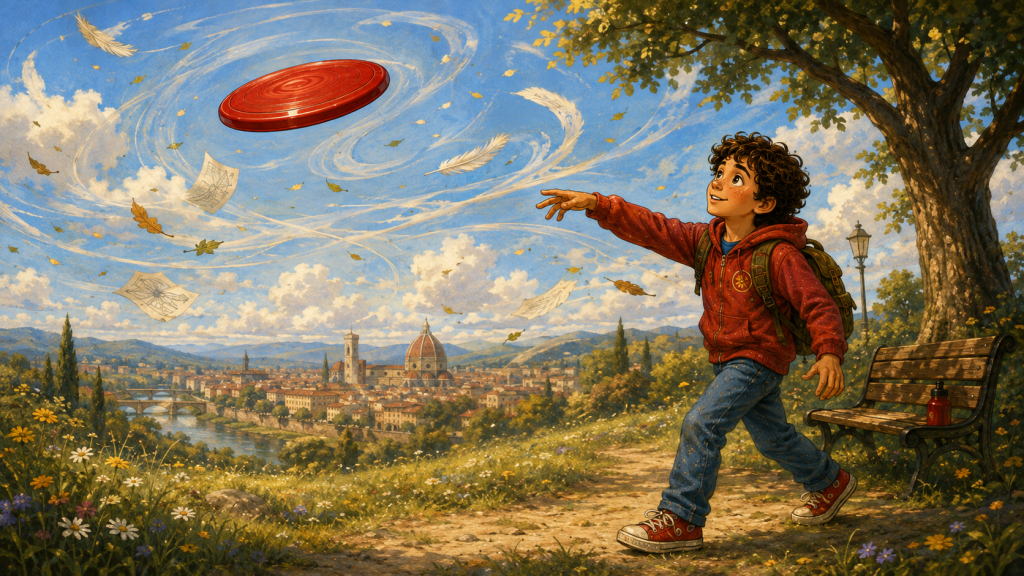
Birds stretched their wings and sailed between the clouds. Leaves spun on the breeze. Seeds drifted away from trees as though they already knew where they were going.
And then there was the frisbee.
Rob could send it climbing into the sky, curving across a field, and gliding all the way back to his right hand.
It made flying look easy.
One afternoon, Rob decided to make something else fly.
He folded a sheet of paper into a pair of wide wings and attached them to a small cardboard tube. Then he stood at the edge of the park, held his creation above his head, and gave it a gentle toss.
It turned sideways, flapped once, and dropped directly into the grass.
Rob picked it up. “Not bad,” he said. “Except for the flying part.”
He adjusted the wings and tried again. This time, the little machine climbed for half a second before spinning backward and landing at his feet.
Rob looked at the crumpled wings, then at his frisbee.
He threw it high into the air. The red disc rose smoothly, levelled out, and sailed across the park before beginning its long curve home.
Rob reached up and caught it cleanly with his right hand.
“Same air,” he said. “Very different journey.”
The Wind began to move through the trees. A feather lifted from the grass, then a scrap of paper followed it, twisting and folding as it rose.
Rob watched the two shapes circle his frisbee.
“Why can you fly,” he asked the disc, “when my wings can’t?”
The Wind curled around him.
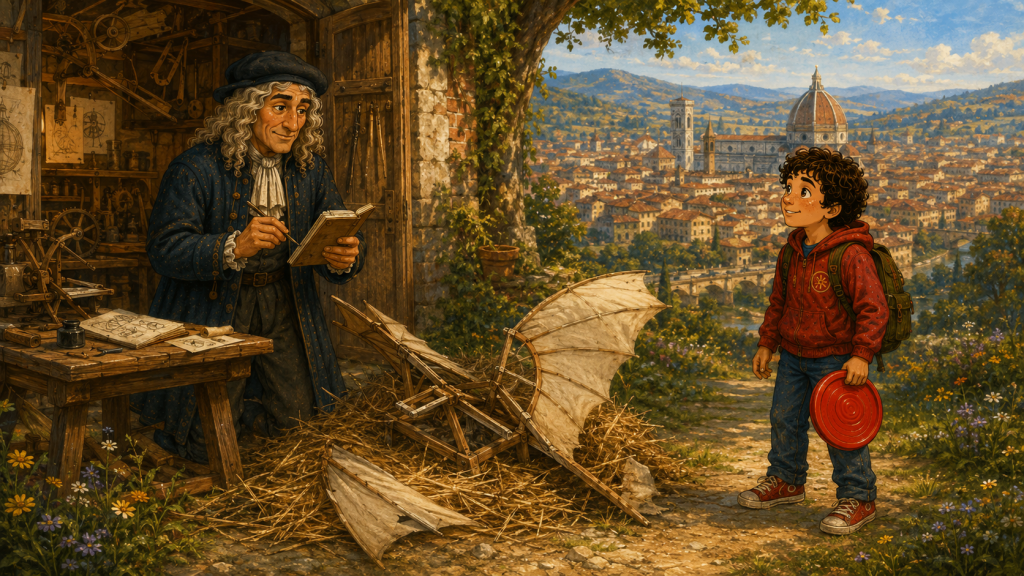
Stone buildings crowded the narrow streets below. Bells rang from a distant tower. Beyond the rooftops, green fields rolled toward the horizon.
A workshop stood nearby with its doors thrown open. Pages covered in sketches hung from the walls. Wings, gears, spirals, bridges, birds, bones, and machines filled every available surface.
Outside the workshop, a man in a dark brown cap stood beside a small wooden table. A strange model rested in front of him.
It had two broad wings, a narrow body, and more string than Rob thought any flying machine should reasonably require.
The man adjusted one of the wings. He checked the balance, then lifted the model carefully and released it from the table.
The machine moved forward.
For one glorious moment, it appeared ready to fly.
Then the left wing folded inward.
The model spun sideways and disappeared into a pile of straw.
Rob waited.
The man opened his notebook and began writing.
“That was almost flying,” Rob offered.
The man looked up. “No,” he said thoughtfully. “But it was excellent falling.”
Rob smiled.
The man walked to the straw, retrieved the model, and examined its folded wing.
“You’re not disappointed?” Rob asked.
“Of course I am.”
He turned the model over. “But disappointment is not the same as defeat.”
He made another note. “This wing failed first. That is useful.”
Rob stepped closer.
The man noticed the red frisbee beneath Rob’s arm.
“And what sort of machine is that?”
Rob held it out. “This one actually flies.”
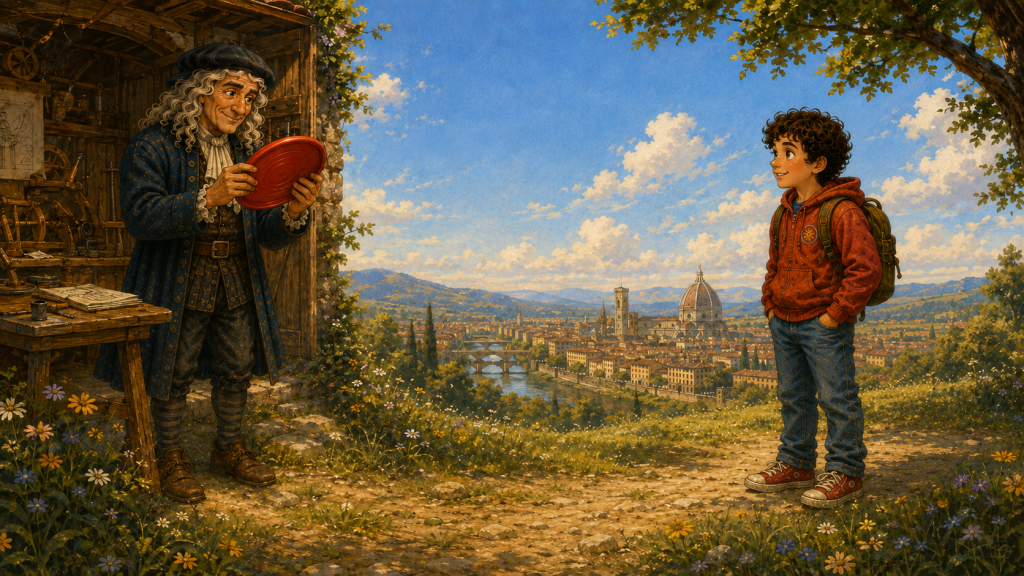
He traced the rounded edge with one finger. He examined the shallow curve. He held it at eye level, then tilted it toward the light.
“It has no feathers,” he said.
“No.”
“No joints.”
“No.”
“No strings, frame, or moving wings.”
“Also no.”
The man turned it over once more. “And yet you claim it flies.”
Rob smiled. “Would you like to see?”
The man handed it back immediately.
Rob stepped into the open field beside the workshop. The man stood several paces away, notebook ready.
With one smooth motion, Rob threw the frisbee with his right hand. It climbed above the grass, glided across the hillside, and curved gently through the afternoon air.
The man’s pencil raced across the page.
The frisbee turned back toward Rob, and he caught it cleanly with his right hand.
For a moment, the man simply stared. Then he looked down at his sketch, then back at the frisbee.
“Again.”
Rob threw it again.
This time, the man watched the front edge.
“Again.”
He watched the angle.
“Again.”
He watched the spin.
By the fifth throw, Rob was beginning to suspect he had become part of an experiment.
The man finally lowered his notebook.
“It is not simply falling.”
“No.”
“It is moving forward while the air presses against it.”
Rob nodded. “And the spin helps it stay steady.”
The man’s face brightened. “A wing that turns itself.”
He opened to a fresh page. “Leonardo da Vinci.”
“I’m Rob.”
Leonardo began sketching the frisbee from above, then from below, then from the side.
Rob peered over his shoulder. “You know you’re allowed to throw it too.”
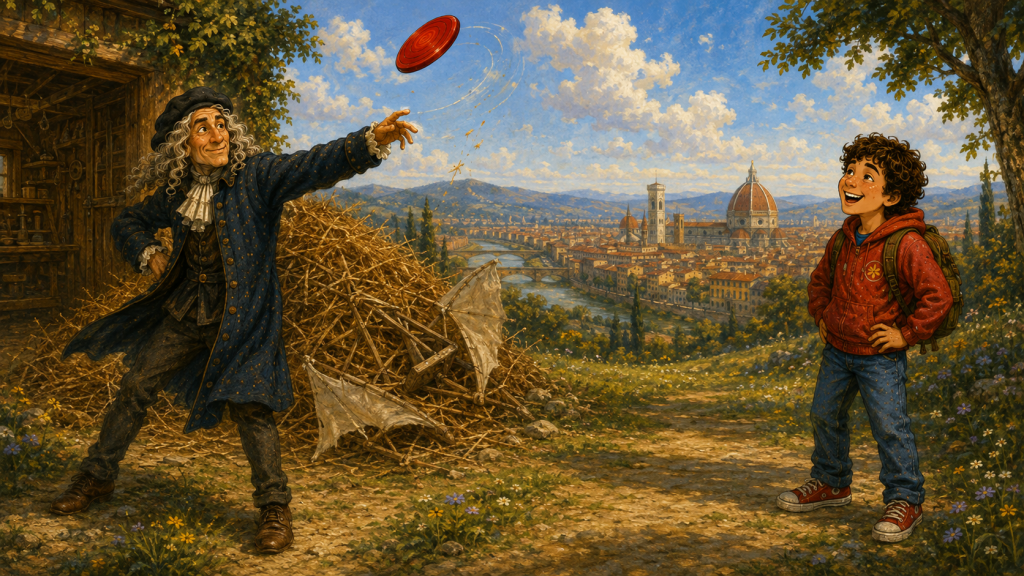
He held it too tightly.
Rob noticed. “You don’t have to defeat it.”
Leonardo loosened his grip. He shifted his feet, drew his arm back, and threw.
The frisbee shot almost straight upward. It climbed above Leonardo’s head, slowed, and hung in the air.
Then it dropped behind him and landed softly in the same pile of straw as his flying machine.
Rob covered his mouth.
Leonardo looked at the empty space in front of him, then turned around.
The frisbee rested upside down in the straw.
“A promising beginning,” he said.
Rob burst out laughing.
Leonardo smiled and retrieved it. “It travelled upward.”
“That’s true.”
“It remained in the air.”
“Briefly.”
“And it landed without breaking.”
Rob nodded. “That might be the frisbee’s greatest advantage.”
They tried again.
Leonardo’s second throw tilted sharply and rolled along the ground. His third wobbled through the air. His fourth flew several metres before turning and landing near Rob.
Leonardo’s eyes lit up. “Better.”
“What changed?” Rob asked.
“The angle was flatter. I released it sooner. And I gave it more spin.”
Rob smiled. “You noticed.”
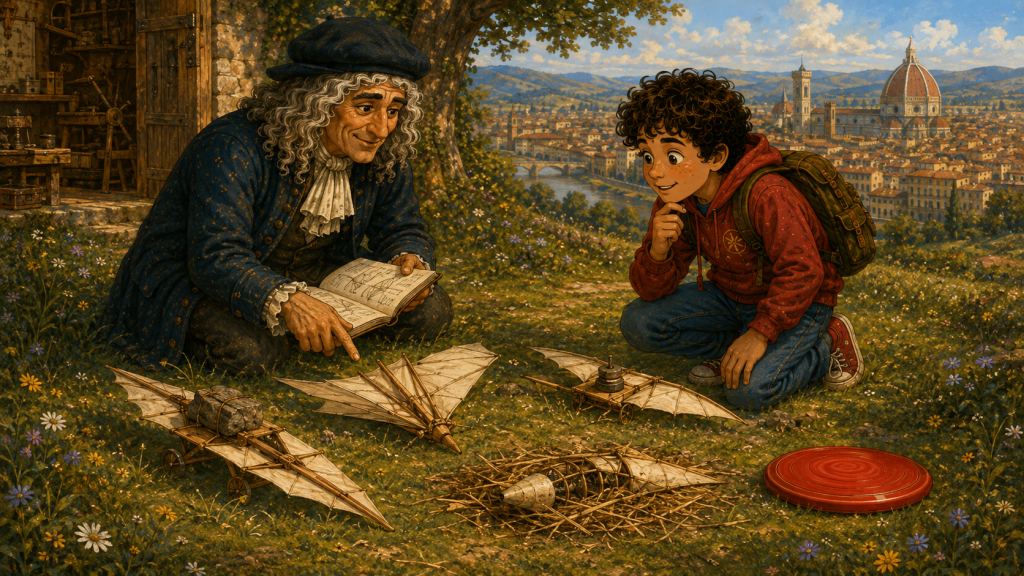
The first had broad wings but was too heavy. It dropped almost immediately.
The second was lighter, but its narrow wings folded inward.
The third spun in a circle and landed behind them.
Rob looked at the growing collection of failed machines scattered across the grass.
“This isn’t going very well.”
Leonardo crouched beside the first model. “This one showed us that the body was too heavy.”
He moved to the second. “This one showed us that the wings needed stronger supports.”
He picked up the third and turned it over. “This one showed us that the weight was too far to one side.”
Rob looked toward the straw, where another model had landed nose-first.
“And that one?”
Leonardo studied it carefully. “That one showed us that straw is softer than stone.”
Rob laughed.
Together, they adjusted the best model. They widened one wing. They moved a small weight closer to the centre. They shortened the tail and strengthened the frame with a thin strip of wood.
Leonardo drew every change.
Rob watched him cross out lines, redraw shapes, and add notes around the edges.
“You keep drawing the parts that didn’t work.”
“Especially those parts.”
“Why?”
Leonardo looked up. “Because the part that failed is often the part that tells us what to change.”
They carried the model to the top of a gentle slope.
Leonardo held it level. Rob checked the wings.
They released it together.
The model moved forward.
It dipped.
Wobbled.
Nearly turned.
Then it steadied.
For several seconds, it glided above the grass before landing safely farther down the hill.
Rob cheered. “We did it!”
Leonardo was already opening his notebook.
Drawing the Next One
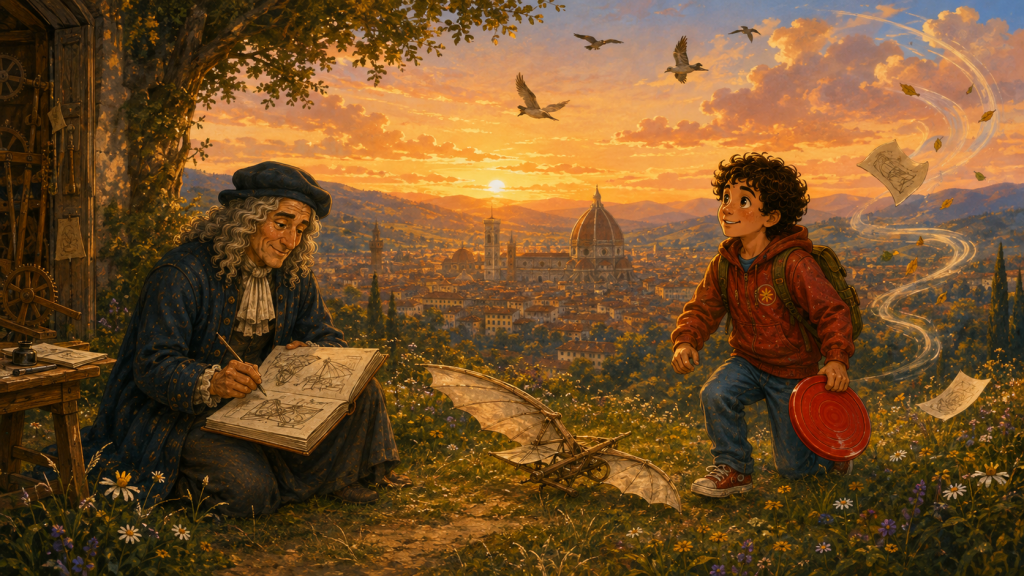
Rob walked down the hill and retrieved the model.
When he returned, Leonardo was sketching a new set of wings.
“What are you doing?” Rob asked.
“Drawing the next one.”
“But that one worked.”
Leonardo looked toward the model in Rob’s hands. “It worked better.”
Rob considered the difference.
The machine had not crossed the sky. It had not carried anyone over the hills. It had glided only a short distance before returning to the ground.
But it had travelled farther than the first, and the second, and all the ones that came after them.
It was not the end of the idea.
It was the next step.
A flock of birds passed overhead.
Rob and Leonardo watched as they changed direction together. Their wings tilted. Their feathers shifted. Their bodies rose and fell with the moving air.
Rob looked at the model, then at the frisbee.
“The air pushed against every shape we tried,” he said. “But it didn’t push against them in the same way.”
Leonardo nodded. “Air is invisible. Its effects are not.”
The breeze strengthened. Grass leaned across the hillside. Loose pages fluttered outside the workshop.
Rob held the frisbee out in front of him and felt the Wind pressing beneath its edge.
“What changes when the air moves faster?”
Leonardo smiled. “That sounds like another question.”
The Wind swept through the field. Sketches lifted into the air. Feathers circled the frisbee. The hillside began to fade.
Rob turned toward Leonardo.
“Do you think people will ever fly?”
Leonardo looked up at the birds.
“Not by wishing to be birds.”
He glanced toward the sketches, the models, and the red frisbee.
“But perhaps by learning from them.”
The Wind lifted Rob from the hillside.
When he returned to the park, his little paper-winged machine was still resting in the grass.
Rob picked it up.
He did not throw it again right away.
First, he looked at the bent wing, then at the weight, then at the shape.
He unfolded the paper and began again.
The first design had not been useless.