One of the biggest mistakes people make when introducing kids to frisbee is assuming that throwing should be the starting point. It feels logical because, to most people, frisbee is about throwing and catching, and if you hand a child a disc, the natural instinct is to say, “Find a partner,” and then hope something good happens from there. But what feels logical is not always what is developmentally appropriate for a child, and that is where a lot of frisbee instruction begins to go off course.
Many frisbee players/Phys Ed teachers will even go as far as getting “safer” frisbees to try and mitigate the danger of throwing & catching with young children. But the reality is that it’s not about the frisbee, it’s about the activity. I use the same frisbee for all ages and just adapt the activity. The wrong approach is doing the same activity for all ages and adapting the frisbee.
Young children are still learning how their bodies move, how objects move, how to manage frustration, how to focus, how to wait, how to share space, and how to coordinate all of those things at once. So when we hand them a disc and ask them to perform a fairly advanced skill right away, we are often starting with the end instead of the beginning. Then, when the throw is wobbly, the catch is missed, or the kids lose interest, we act as though the problem is the child. More often than not, the problem is the progression.
We Already Know Better in Other Activities
What is funny is that this idea is not complicated at all when we look at almost any other activity.
When kids start swimming, they do not begin with polished strokes and efficient breathing patterns. They begin by putting their face in the water, blowing bubbles, splashing, floating, and slowly learning to feel comfortable in an environment that is unfamiliar. When kids learn to skate, they do not step onto the ice and immediately start playing hockey. They scrape the ice, make snow, wobble, fall, get back up, and gradually build the balance and control that skating requires. In gymnastics, kids do not start with routines. They roll, hang, crawl, balance, and explore.
For some reason, frisbee often gets robbed of that same developmental patience. Adults skip over the comfort stage and move straight to the performance stage. They want the activity to look like the sport they know, and they want it to look that way quickly. But kids do not need frisbee to look impressive to adults. They need frisbee to make sense in their body.
The Frisbee Should Often Start on the Ground
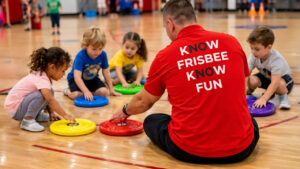
For young kids, especially 4-6 year olds (Kindergarten to Grade 2), I do not believe throwing should be the first thing they do with a frisbee. I think the first job is helping them become comfortable with the frisbee itself, and one of the best ways to do that is by starting with the disc on the ground.
That may seem too simple to people who are eager to get to “real frisbee,” but that kind of thinking is exactly the problem. A frisbee is not just a thing you throw. It is an object that spins, slides, rolls, flips, glides, curves, stops, and reacts to touch in ways that are very different from a ball. Before kids are expected to throw it through the air, they should have time to explore how it behaves.
When a child spins a disc on the floor, rolls it to a target, flips it over, traps it, stops it with a hand or foot, or nudges it and watches how it changes direction, that child is not wasting time. That child is building familiarity. They are learning how the object moves. They are beginning to understand angle, force, control, timing, and touch. Just as importantly, they are developing comfort and confidence, which is the real starting point for any meaningful skill development.
When a ball dreams, it dreams that it’s a frisbee
Dr. Stancil Johnson
Physical Literacy Comes Before Frisbee Skill
This is where a physical literacy perspective matters so much. Physical literacy is not about rushing kids toward the official version of a sport as quickly as possible. It is about helping them build competence, confidence, coordination, and control through movement experiences that make sense for their stage of development.
That means frisbee should not be approached only as a sport-specific skill set. It should be approached as a movement tool, a play tool, and a teaching tool. The disc can help kids develop spatial awareness, balance, self-control, object manipulation, patience, tracking, timing, and hand-eye coordination long before they are ready to play any formal version of the sport. Those are not bonus outcomes. Those are the foundation.
Too often, people look at early frisbee exploration and think it is somehow less than the “real thing.” I would argue the opposite. For a young child, that is the real thing. That is the beginning. That is the doorway. If we skip that stage because we are too eager to see passing and gameplay, we are not being efficient. We are being impatient.
For more on the sport of frisbee as a physical literacy tool, read this article I wrote a few years ago: https://frisbeerob.com/2018/11/25/physical-literacy-through-frisbee.
Making a Mini Game Is Not the Same as Building a Better Progression
This matters because many adults try to make frisbee more kid-friendly simply by shrinking the game. They create a smaller field, use fewer players, reduce the rules, and assume that they have now made ultimate developmentally appropriate.
Sometimes that can be useful later on, but it is not automatically the right starting point. Making a game smaller does not necessarily make it more appropriate. It just makes it smaller.
If kids still lack the underlying skills to throw, catch, move with awareness, manage space, make decisions, and control their emotions in a game environment, then all we have done is create a smaller version of something they are not yet ready for. The issue was never just the size of the game. The issue was the sequence.
Kids do not need a mini version of the finished sport nearly as much as they need a better pathway into it.
Frisbee Is Bigger Than the Version Most Adults Know
Another challenge is that many of the people introducing frisbee to others only know one version of it. Most ultimate players know ultimate. Most disc golfers know disc golf. And because that is the version they know and love, that becomes the version they teach. The problem is that they are often coming at it from a point of lack without realizing it. They do not know what they do not know, and because of that, they cannot teach what they have never experienced.
That is not a criticism of ultimate players or disc golfers. It is just reality. People teach from their own frame of reference. But the sport of frisbee is much bigger than the slice most people are familiar with.
Frisbee is not just ultimate. It is not just disc golf. It is not just freestyle or guts or self-caught flight or accuracy or double disc court. Frisbee is more like track and field than a single sport. It is a broad family of disciplines, movements, games, challenges, and possibilities built around one flying object. If we step back and take a more holistic view, we open up far more entry points for people.
For a complete list of disciplines, visit https://agelessgame.com/disciplines.
And that matters, because not every child is going to connect with the same version of frisbee. One child may love rolling and spinning games. Another may love target challenges. Another may love trick throws. Another may eventually fall in love with ultimate because of the teamwork. Another may never play organized frisbee at all, but may still benefit from the movement, the fun, and the confidence that came from early experiences with the disc. Some kids like team sports. Some like individual sports. Some don’t like sports.
That is all valuable.
The Sport Is Not “The Best” and We Need to Get Over Ourselves
I think this is where ego quietly gets in the way of good teaching. People who love a sport often want others to love that sport in the exact same way they do. They start believing, even if they do not say it out loud, that their sport is the best sport in the world and that if people just experience it properly, they will obviously agree.
But that is not how people work, and it is not how healthy sport introduction should work either.
Frisbee is not the best sport in the world. It is a great sport. It is a versatile sport. It is a fun and creative and deeply valuable sport. But it is not automatically the right fit for everyone, and we should be honest enough to admit that. If someone ends up loving frisbee because they love the frisbee, great. If they enjoy it, learn from it, and then choose soccer because that is where their friends are, great. If they move toward basketball, dance, hockey, or track because that is where they find their people and their sense of belonging, great.
The goal when introducing frisbee should not be to recruit at all costs. The goal should be to create such a positive, developmentally appropriate, engaging experience that people genuinely get to discover what is possible. Then they can find their own path.
People Stay in Sports Because of the People
This is another part of the conversation that does not get talked about enough. One of the biggest reasons people love the sport they play is because of the people. They love their teammates, their training group, their weekend routine, the coach who believed in them, the community they built, the sense of belonging that sport gave them. In many cases, what they really love is not just the activity itself, but the life and relationships wrapped around it.
That is important, because when a child or an adult is being introduced to a sport for the first time, they do not already have that community in place. They do not yet have the friendships, the inside jokes, the shared experiences, or the emotional attachment that long-time players have. So we cannot assume they will care about frisbee the same way we do just because we already care about it.
That means the early job is not to sell them on our nostalgia, our subculture, or our favourite format of the game. The early job is to show them that a frisbee is fun, that movement with a disc can be playful and engaging, and that there are many different ways into this world. From there, people can build their own relationship with it based on their own family, friends, interests, and community.
If frisbee becomes their thing, wonderful. If frisbee becomes one stepping stone in a larger athletic journey, that is wonderful too.
Fun First, Breadth First, Pressure Later
If we really take a holistic view of frisbee, the first phase should be broad, playful, and inviting. It should not be narrow, technical, and overly attached to one discipline. Let kids roll the disc. Let them spin it. Let them throw at targets. Let them invent games. Let them work with a partner. Let them move on their own. Let them explore different kinds of discs, different kinds of challenges, and different ways of succeeding.
That broader introduction does two things. First, it helps children build real physical literacy and real comfort with the object. Second, it gives them a more honest picture of what frisbee can be. Instead of introducing frisbee as though it is only one thing, we introduce it as a world with many doors.
That matters because people do not all enter through the same one.
Start With the Child, Not With the Sport’s Ego
At the heart of all of this is a simple idea. Good teaching does not begin with the adult’s favourite version of the sport. It begins with the learner.
If we want kids to eventually throw well, catch well, play well, and maybe even fall in love with frisbee, then we need to stop trying to impress them with the finished product before they are ready. We need to stop pretending that shrinking ultimate automatically solves the problem. We need to stop assuming that our own pathway into sport should be everyone else’s pathway too.
Instead, we should start where the child actually is. We should help them get comfortable with the frisbee. We should use the disc to build movement skills, confidence, and curiosity. We should make the experience broad, fun, and engaging enough that they get to feel what is possible. And then, over time, we should let them find their own path based on what they enjoy, who they enjoy it with, and what kind of community they want to be part of.
That is not lowering the standard for frisbee. It is raising the standard for how we introduce it.
And if we did that more often, I think more people would not only enjoy frisbee, but actually have a fair chance to discover what it can become in their life.


