
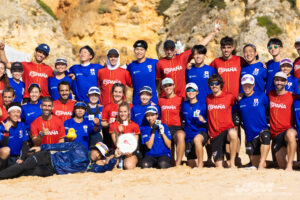
The more time I spend around frisbee, the less I think growing the sport is actually about frisbee.
I know that sounds strange coming from someone who has built much of his life around a flying disc, but it’s something that has become clearer to me over the years. I’ve spent decades playing, competing, teaching, speaking in schools, organizing events, and introducing hundreds of thousands of kids to frisbee. Through all of that, I’ve met incredible athletes, coaches, volunteers, families, and friends, and I’ve come to realize that people rarely stay involved because of the object in their hands. They stay because of the people around them and the relationships they build along the way.
Whenever the conversation turns to growing ultimate, disc golf, or any other disc sport, we naturally start talking about the sport itself. We discuss better coaching, more tournaments, stronger marketing, social media, television coverage, sponsorships, college opportunities, or the possibility of getting ultimate into the Olympics. Those conversations all have value, but I don’t think they are where growth begins.
Growth begins with community.
Kids Follow Their Friends
One of the biggest lessons I’ve learned from working in schools is that kids don’t usually choose sports the way adults think they do. We like to believe that a child discovers a sport, falls in love with it, and then makes friends through that shared experience. Sometimes that happens, but more often it works the other way around. Kids follow their friends.
If a child’s friends are playing soccer, there’s a good chance they’ll end up playing soccer. If everyone in the neighbourhood signs up for basketball, basketball becomes the obvious choice. They aren’t simply choosing between different rules, skills, or pieces of equipment. They’re choosing where they will spend their evenings and weekends, who they’ll sit beside on the bench, and whether they’ll be part of the conversations happening at school the next day.
That creates a real challenge for niche sports such as ultimate and disc golf. When we ask a young person to leave the sport all of their friends are playing so they can join a small frisbee program, we’re asking for more than a change of activity. We may be asking them to step away from an established social circle and enter a space where they don’t know anyone. That’s a much bigger decision than adults sometimes realize.
It isn’t enough to tell kids that frisbee is fun and expect them to leave their friends behind to try it. We need to create communities that they want to join.
It’s a Chicken-and-Egg Problem
This is one of the biggest challenges facing frisbee. We need more people playing to make the sport attractive to new players, but attracting new players becomes much easier when there are already active communities for them to join.
Recent participation data from USA Ultimate has created important conversations about why ultimate participation has declined while several other youth sports have continued to grow. It would be easy to look at those numbers and conclude that we simply need to do a better job of telling people how great ultimate is. I think the issue is more complicated than that.
In many communities, a young soccer or basketball player has access to school teams, local clubs, camps, coaches, recognizable athletes, and clear pathways into higher levels of competition. Ultimate and other disc sports often don’t have the same foundation. Programs can be difficult to find, local communities may be small, and there may not be enough young people involved to create the social experience kids are looking for.
That doesn’t mean the sport is less valuable. It means we have more foundational work to do so people can discover both the sport and the community around it.
The Connection Has to Work at Every Level
For the past decade, I’ve also had the opportunity to see this challenge from another perspective through my involvement as a board member/media staffer with the World Flying Disc Federation (WFDF).
WFDF is doing important work to govern, develop, and promote flying disc sports internationally. It represents member associations and athletes in more than 125 countries, and its responsibility extends beyond Ultimate to include Beach Ultimate, Disc Golf, Freestyle, Guts, the individual events, and Overall.
That international work matters, but most players are several layers removed from it. WFDF works with national federations, which often work with provincial or state organizations. Those organizations then connect with the city groups that run leagues, tournaments, clubs, and local programs. By the time someone shows up for their weekly league game, they may not see or understand how they are connected to the international federation at all.
That distance creates a challenge, but it also shows us where the opportunity is. WFDF can create international strategies, resources, events, educational programs, and development opportunities, but those efforts only reach players when every level helps carry them forward. At the same time, the experiences and needs of local players have to move back through that structure so the people making decisions at the regional, national, and international levels understand what is happening in communities.
I also believe our national federations need to think beyond promoting a single discipline. Ultimate may be the largest organized flying disc sport in many countries, while disc golf has a much larger presence in others, but both are part of a much broader flying disc community. Regardless of which discipline someone eventually discovers, the connection usually begins in the same place: one person learning to throw a disc and another learning to catch it. That simple exchange is the shared foundation of flying disc and often the first experience that makes someone want to keep playing.
From there, people can follow very different paths. Someone who has no interest in joining an ultimate league might love disc golf. A person who prefers individual challenges could be drawn to distance, accuracy, or self-caught flight, while someone else may connect with freestyle, Guts, Overall, or simply continue enjoying the experience of throwing and catching in a park.
Those disciplines should not be competing against each other for attention. Together, they give more people more ways to discover flying disc.
If we want the sport to grow, WFDF, national federations, provincial and state organizations, city organizations, clubs, teachers, coaches, volunteers, and players all need to see themselves as part of the same system. Each level has a different role, but none of them can create sustainable growth on its own.
The connection has to work all the way from the international federation to the person picking up a disc for the first time—and it also has to work in the other direction.
Frisbee Doesn’t Need Early Specialization
At the same time, I don’t think growing frisbee means convincing kids to specialize in it at a young age. One of the greatest strengths of frisbee is that people can discover it later in life and still have tremendous success.
I didn’t start playing frisbee until I was eighteen years old. Growing up, I played hockey, soccer, track and field, figure skating, rugby, baseball, basketball, badminton, golf, and swimming. At the time, none of those sports had anything to do with frisbee. I was simply trying different activities, learning new skills, spending time with friends, and figuring out what I enjoyed.
Looking back, though, I know much of the success I’ve had in frisbee came from the foundation those sports gave me. Hockey and figure skating developed my balance, agility, and awareness of space. Baseball taught me to throw and catch, but it also taught me how to deal with being cut from a team. Soccer, rugby, and basketball taught me how to move with teammates, read other players, and make decisions while a game was unfolding. Track and field helped develop my speed and coordination. Badminton improved my reactions and hand-eye coordination, while golf taught me patience, repetition, and the importance of mechanics. Swimming helped build endurance and confidence in a completely different environment.
When I discovered frisbee, I was new to the disc, but I wasn’t new to movement, competition, teamwork, practice, or learning physical skills. I brought all of those experiences with me, and frisbee became a place where many of them came together.
That’s why I don’t worry when kids choose hockey, basketball, volleyball, soccer, swimming, or another sport instead of specializing in frisbee. Those experiences aren’t necessarily taking them away from frisbee. They may be preparing them for it, even if they don’t discover a disc sport until high school, university, or adulthood. Frisbee will still be there when they’re ready.
Not Every Player Needs to Stay Forever
I also think we need to be realistic about what participation looks like over a person’s lifetime. Sometimes we talk about youth development as though every student who joins an ultimate team should still be playing twenty years later, but that isn’t how most sports work.
Many young people leave their school sports behind after graduation. Someone might play volleyball throughout high school and never join another team after moving away for university. Others stop playing basketball, soccer, hockey, or football when they begin careers, start families, or simply develop different interests. At the same time, college and university are often where people discover a completely new sport and find a new community.
That was certainly true for me. I had been throwing a frisbee for about a year when I decided to attend a practice with the Dalhousie King’s Ultimate Team (DKUT). I was curious about ultimate because I already loved throwing, but I didn’t know much about the sport or what to expect when I showed up.
The frisbee was what brought me to that first practice, but the people were what kept me coming back. I became part of a community, and some of the friendships I made through that team have lasted for more than 25 years. I still keep in touch with several of those people today.
I don’t see leaving a sport, taking a break, or discovering something new later in life as failure. I see it as a normal part of how people grow and how their lives change.
What matters is that frisbee remains available when people are ready to discover it, return to it, or experience it in a different way. Someone who played ultimate in high school might join an adult league ten years later. Another person might discover disc golf through coworkers. Someone else might start playing catch with their own children and remember how much they enjoyed it. They may even discover freestyle, Guts, Overall, or another part of frisbee they never knew existed.
One of the best things about frisbee is that there are so many entry points, and those opportunities can appear at any stage of life. Instead of worrying about keeping every player forever, we should make sure there are welcoming places for people to enter, leave, return, or try something new when the timing is right.
We Need to Build More Than Players
When I step back and look at the bigger picture, I don’t think the future of frisbee depends only on producing better players or more elite athletes. It depends on building stronger communities.
That means creating local clubs, school programs, beginner events, community leagues, tournaments, disc golf courses, public spaces, and informal opportunities where people can simply show up and play. It means helping teachers feel comfortable introducing frisbee in PE classes, supporting volunteers who organize programs, and creating environments where beginners don’t feel as though everyone else already knows what they’re doing.
That is what I’m trying to do through Frisbee Club: create a place where people can come together to play, meet others, and build a community through frisbee. I also want to help others create similar opportunities in their own communities.
We also need more heroes who inspire people to pick up a disc, but inspiration needs somewhere to go. If a child sees an incredible ultimate play, a huge disc golf drive, or a world-record throw but has no club, coach, event, or welcoming place to try it, that excitement can disappear quickly.
I’ve tried to spend my career bridging some of those gaps through school workshops, community events, coaching, writing, Frisbee Friday, and resources for teachers and program leaders. But growing frisbee is much bigger than any one person. It takes teachers, parents, coaches, volunteers, organizers, players, and communities working together over many years.
The goal isn’t simply to place a frisbee in someone’s hand. It’s to make sure there are people beside them, somewhere to play, and a reason to come back.
It Was Never Only About the Frisbee
The frisbee is what first pulled me in, and it is still a huge part of why I keep going. I love the challenge, the creativity, the pursuit of a better throw, and the feeling of doing something I once thought was impossible. Those moments matter.
But they are only part of the story.
The story is abour the Finite vs the Infinite Game. The records, medals, wins, and losses are part of the finite game. They have a result, a finish line, and a moment when they end. The infinite game is what continues after those moments: the road trips, the conversations between games, the people who welcomed me into their homes, the teammates who supported me, and the friendships that have lasted for decades.
I may have been attracted to frisbee because of the disc, but what I’ve created, what I’ve learned, and what I continue to do would not have been possible without the community around it. The frisbee gave me a challenge to pursue. The people gave that pursuit meaning.
That is why growing frisbee can’t only be about convincing more people that the sport is fun. It has to be about creating both: opportunities for people to fall in love with the disc and communities that give them a reason to stay connected.
The frisbee may be what brings us together, but the game and the people are what keep us coming back.
Interested in starting a Frisbee Club in your community? Get in touch.