
Over the past number of years, I’ve had the chance to work with more than 250,000 students, alongside over 1,000 teachers, across more than 8,000 workshops.
When you spend that much time in gyms, on fields, and in classrooms, patterns start to show up.
One of the biggest ones is this:
- When kids are introduced to frisbee through ultimate first, many of them struggle.
- When they’re introduced to the frisbee first, almost all of them find a way in.
That difference matters.
Start With the Disc, Not the Game
In schools, I don’t start with ultimate. I start with the disc.
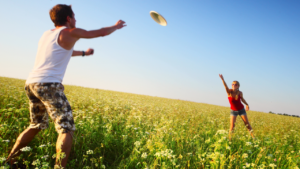
We throw. We catch. We experiment. We miss. We try again. Kids figure out what happens when they change their angle, their grip, their timing. They start to feel what a good throw is, not because I explained it perfectly, but because they experienced it.
That’s how learning sticks.
If we skip that stage and move straight into a structured game, we’re asking kids to operate inside a system before they even understand the tool they’re using. It’s like asking someone to play a game of chess before they know how the pieces move.
Some kids will figure it out anyway. A lot won’t.
A Frisbee Is More Than One Sport
Another thing that becomes obvious in schools is that not every kid connects with the same thing.
Some love throwing as far as they can. Some get hooked on accuracy challenges. Some enjoy creative movement and trick throws. Some thrive in partner work. And yes, some eventually fall in love with ultimate.
But that only happens when they’re given the chance to explore.
Frisbee isn’t just one sport. It’s a whole range of possibilities. When we treat it that way, we give more kids a way to feel successful early on. When we narrow it too quickly, we lose some of them before they even get started.
The Social Piece Is Real
One thing that often gets overlooked is how much sports are shaped by community.
Kids don’t just choose activities based on the activity itself. They choose based on where their friends are, where they feel comfortable, and where they feel like they belong.
Ultimate is a team sport, which means it relies heavily on that social structure already being in place.
A frisbee doesn’t.
You can play with one other person. You can play in a small group. You can play at recess, after school, or at the park. It’s flexible, and that flexibility makes it a powerful starting point.
When kids build a positive relationship with the frisbee first, they’re much more open to exploring what comes next, whether that’s ultimate or something else.
Development Comes Before Structure
From Kindergarten through Grade 6, kids are still building the foundation of how they move.
They’re learning how to throw, how to catch, how to run, how to react, how to control their body in space. They’re developing balance, coordination, awareness, and confidence. And they do that best when they’re exposed to a wide range of games and activities, not when they’re pushed too early into a structured system.
Ultimate asks for a lot. Spacing, timing, decision-making, teamwork. Those are skills that develop over time.
By the time kids reach middle school, many of them are far more ready for that environment.
If they already feel comfortable with a frisbee, that transition becomes natural.
What I See When We Get It Right
When kids are given the chance to explore the frisbee first, everything changes.
- They engage more.
- They take more risks.
- They start to figure things out on their own.
You can see the moment it clicks for them. A clean throw. A catch they didn’t think they could make. A small breakthrough that turns into confidence.
From there, the learning accelerates.
Not because we pushed them harder, but because we gave them the right starting point.
Let Frisbee Do Its Job
I’m not against ultimate. I love ultimate. That’s how I got started playing when I was 18 years old – only after I had been throwing by myself for a year, learning what a frisbee could do, and the simple joy in discovering the flight.
But I’ve learned that it’s not the best place to begin.
If we want kids to enjoy frisbee, build confidence, and stay engaged, we need to start with something simpler, more flexible, and more aligned with where they are.
Start with the disc. Let them play. Let them explore. Let them succeed in small ways first.
And then, when they’re ready, introduce ultimate as one of many ways they can keep going.
Because ultimate is a great sport. But it’s not the starting point.
Frisbee is.