
Some Phys Ed games work because they are simple. Some work because they are competitive.
And some work because, as the instructor, you get to be just a little bit sneaky.
The Ladder Game is one of my favourite frisbee games for Grades 5-12 because it takes a basic throwing and catching activity and turns it into a fun, fast-moving challenge full of pressure, teamwork, listening, and laughter.
It was first introduced to me by Noah VanSickle in 2023 at Balmoral Public School in the Peel District School Board, and I’ve been using and adapting it ever since.
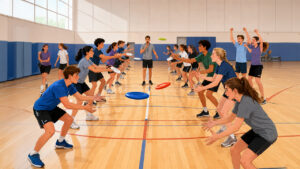
The setup is simple: students partner up, each with one frisbee, and stand across from each other in two lines. I usually start them about 10 feet apart – close enough for success, but far enough that they still have to focus.
The goal is to stay near the top of the ladder.
If you and your partner complete the challenge, you stay where you are or move up as other teams make mistakes. If you drop the frisbee, throw at the wrong time, break the round’s rule, or fail the challenge, you and your partner go to the bottom of the ladder.
Yes, both of you. That is part of what makes the game so good.
Students quickly learn that this is not just about throwing and catching. It is about listening, being honest, encouraging your partner, and handling mistakes without falling apart.
Round 1: Throw and Catch
The first round is beautifully simple. Students can throw and catch any way they want.
But they can only throw when they hear the whistle.
One whistle. One throw. No whistle. No throw.
This is where the fun starts.
I’ll say, “Ready… 3… 2… 1… throw!”
But I won’t blow the whistle.
A bunch of students usually throw anyway – bottom of the ladder.
Then I might try it again.
“Ready… set… throw!”
Still no whistle – bottom of the ladder.
It is amazing how quickly students start locking in once they realize they have to listen for the actual cue, not just react to the rhythm of the countdown.
I’ll give them a chance to really dial-in with this round before moving onto the next. At first I’ll cue them with “Ready, Set, *blow whistle”. But as I get going, I’ll just blow the whistle, and not say any cues.
Round 2: Spin Before You Catch
Once students understand the basic flow, I add a challenge.
In this round, the catcher has to complete a full 360-degree spin before catching the frisbee.
The thrower should wait until their partner finishes spinning before they throw.
And, just like before, students can only throw on the whistle.
This round adds movement, timing, patience, and a bit of chaos. Some teams rush. Some forget to spin. Some make incredible catches. Some fall apart and then laugh their way to the bottom of the ladder.
That is exactly why it works.
Round 3: Silent Frisbee
For this round, the throwing and catching goes back to normal.
No spinning. No one-handed catches. Nothing fancy.
But now the challenge is silence.
No talking. No laughing. No clapping.
Only throw on the whistle.
Before starting, I might say something like:
“This group has been at the top for a while. Let’s give them a round of applause.”
And, almost every time, a bunch of students start clapping – Bottom of the ladder.
Silent Frisbee is one of my favourite versions because it changes the whole feel of the room. Students have to control their reactions, stay focused, and take responsibility for themselves.
It is simple, but it is not easy.
Why The Ladder Game Works
The Ladder Game is great because it creates pressure without needing a complicated setup.
Students are practising throwing and catching, but they are also practising: listening, patience, honesty, teamwork, self-control, resilience, and how to respond when their partner makes a mistake.
The ladder keeps changing. Teams move up. Teams drop down. Nobody is out. Nobody is stuck. Everyone keeps playing.
And as the instructor, you can adjust the rounds depending on your group, your space, and how much time you have.
You can add one-handed catches, opposite-hand throws, balance challenges, pivot foot rules, upside-down throws, or even let students create their own rounds.
Download the One-Page Teacher Guide
I created a simple one-page PDF that PE teachers can print off and use as a quick reference for running The Ladder Game.
It includes the setup, rules, sample rounds, teacher cues, and extra variations so you can bring it into your next class without having to remember every detail.
Simple setup. Lots of movement. Built-in teamwork. Plenty of chances to laugh, reset, and try again.